

TL;DR (Executive Summary)
- AI-generated code has outpaced what most internal QA teams can verify. Adoption of AI coding tools is nearly universal, and CI/CD reliability has slipped as a result, which is why outsourcing testing is a live decision again in 2026.
- Outsourcing fits three specific situations, not "whenever budget allows." Review capacity outpaced by code output, automation coverage plateaued near a hard ceiling, or a compliance audit that needs traceability you can't yet produce.
- The engagement model matters more than the vendor's brand. Staff augmentation, project-based work, a managed service, and an AI-native model with human validation solve different problems, and picking the wrong one is a common, avoidable mistake.
- Most outsourced QA engagements fail in one of four specific ways. Context reset, coverage theater, code lock-in, and a gap between a vendor's claimed AI maturity and what actually ships. Each one has a specific question that exposes it.
- A real 30-day pilot beats any vendor's claimed numbers. Score coverage, defect escape rate, turnaround time, and code ownership at a fixed checkpoint before committing budget.
Outsourced software testing services are a live decision again in 2026, and the decision rarely comes down to a single yes-or-no question. The real sequence runs through four steps. Whether outsourcing fits your situation, which engagement model matches it, how to catch the specific ways an engagement quietly fails, and how to prove a vendor's claims before committing budget. This guide walks through each one in order.
AI Code Output Has Outpaced What Internal QA Teams Can Verify
Ninety-three percent of engineering organizations have adopted AI coding tools, and 40% already generate more than 40% of their own code with AI. Seventy percent of engineering leaders are already concerned application quality is suffering as a result [1].
Main-branch success rates fell to 70.8% in early 2026, a five-year low against the 90% benchmark healthy teams run at. They recovered to 76.7% by the second quarter, still well under that benchmark [2].
The market for outsourced software testing services reflects the same pressure. One 2026 estimate puts it at roughly $70 billion this year, and every major research firm tracking it projects double-digit annual growth through the decade, even though the exact figures vary by methodology [3].
Test maintenance itself has become one of the most commonly reported pain points in automation programs, growing sharply as UI and feature churn compounds year over year. A team already stretched thin on writing new coverage often loses even more time just keeping existing scripts alive.
Release velocity keeps climbing. Verification capacity does not climb with it. That gap is why outsourcing testing is back on the table in 2026, and capacity is the driver behind it.
Outsourced Software Testing Makes Sense in Three Specific Situations
Quick answer: Outsourcing software testing makes sense once AI-generated code has outpaced what your team can verify, automation has plateaued near a 25% ceiling, or an audit needs traceability you can't yet produce. Which engagement model fits depends on why you're outsourcing. Staff augmentation covers a temporary gap, a managed service takes full outcome ownership, and an AI-native model pairs AI-generated scripts with a QA engineer's validation for teams that need speed and audit-ready evidence. Prove the fit with a fixed-scorecard pilot before committing budget, rather than taking a vendor's claimed numbers on faith.
Three signals are worth checking against your own situation before anything else.
The compliance signal is worth naming specifically, since it's the one most engineering leaders underestimate. A team operating under SOC 2, HIPAA, or PCI-DSS eventually needs to show an auditor evidence of what was tested and when, not just a passing build.
A manual QA process that has never had to produce that evidence for an outside auditor often discovers the gap during the audit itself, which is a costly time to discover it.
A single QA hire can close a capacity gap that isn't yet structural, which is often the right call for a smaller engineering org before looking at any vendor. A small application with an infrequent release cadence rarely justifies the overhead of a vendor relationship, even a good one. The cost of skipping verification entirely is real either way.
Poor software quality costs US organizations an estimated $2.41 trillion a year, a figure that hasn't been meaningfully updated since 2022 but hasn't gotten smaller either [5].
Build-versus-buy usually resolves once these signals are checked. If review capacity, coverage, and compliance all point the same direction, the outsourcing question answers itself. The harder question, and the one most guides skip, is which engagement model fits what you actually need.
Outsourcing QA Testing Comes Down to Four Engagement Models
Four models cover most outsourced QA testing arrangements. Each solves a different problem, and picking the wrong one for your situation is a common, costly mistake at this stage.
- Staff augmentation adds temporary hands to a team that keeps its own process. It fits a short-term capacity gap. Picking this model for a permanent coverage need just delays the real hiring or vendor decision by a quarter.
- Project-based work delivers a fixed, defined scope in a short window. It fits a one-time need, like testing a major release, rather than ongoing coverage.
- A managed service hands full ownership of strategy and execution to a provider. It fits a team that wants QA off its plate entirely, and it usually comes with the longest onboarding.
- An AI-native model with human validation pairs AI-generated test scripts with a QA engineer who validates every script before it's trusted. It fits a team that needs speed and audit-ready evidence without losing visibility into its own test suite.
Whichever model fits, one requirement should hold regardless. A human being checks the AI's output before anything downstream trusts it. That requirement is easy to state and surprisingly easy for a vendor to quietly skip, especially under a fixed-price or per-run contract where a faster review cycle looks like margin instead of risk.
A skipped validation step rarely shows up on day one. It shows up months later, as a defect that already reached production, or as a suite that keeps reporting green while a real regression sits underneath it.
That's part of the same throughput mismatch already straining QA backlogs elsewhere in the pipeline, and the next section covers exactly how the skip shows up in practice.
See what an AI-generated, engineer-validated script actually looks like before you sign an engagement. Claim a $0 Testing Sprint for one test case, or get your estimate scoped to your application.
Four Failure Modes Undermine Most Outsourced QA Engagements
An engagement can use the right model and still fail. Four failure modes account for most of the outsourced QA relationships that quietly stop delivering value.
- Context reset. Vendors that rotate engineers across clients to maximize utilization create a hidden cost. A new tester typically needs three or more weeks just to learn a product's business rules and deployment pipeline. A client pays for months of an engagement and gets only weeks of genuinely ramped-up output, every time the account rotates [6].
- Coverage theater. A test suite can report high coverage while missing real defects. This shows up most clearly with AI-generated tests: when a test's expected values come from the same code being tested rather than an independent specification, the test can pass without meaningfully checking anything. A team can carry strong-looking coverage numbers and still ship the same bugs a thinner suite would have caught.
- Code lock-in. Automation that lives inside a vendor's platform, rather than as code the client can open and keep, creates a dependency that's expensive to unwind. A vendor's pricing architecture often comes down to this exact question, what you actually own if the engagement ends.
- Claimed-versus-actual AI accuracy. A vendor's marketing can describe far more AI maturity than its production process actually delivers. Industry-wide, 89% of organizations are piloting or deploying generative AI in quality engineering, but only 37% have it in production, and just 15% have reached full enterprise-wide implementation [7]. A vendor's sales deck rarely specifies which of those three tiers it's actually operating at.
Automation quality itself varies the same way. A script that only checks whether a page loaded is a shallower kind of coverage than one that verifies the actual business rule behind the workflow. A vendor's reported test-case count doesn't distinguish between the two, so two vendors quoting the same number can be delivering very different depth.
These four failure modes rarely show up in isolation. A vendor rotating engineers to save cost is also the vendor most likely to let coverage theater slide, since a rotated tester has less context to notice a shallow test in the first place.
Asking about one failure mode on a vendor call is usually a fast way to surface the other three.
Questions That Expose Each Failure Mode on a Vendor Call
- Who specifically works my account, and for how long? A vendor that answers with company-wide attrition numbers instead of a named engineer's tenure is dodging the question.
- Where do a test's expected values come from? If the answer is "the code we just tested," the coverage number attached to that test is worth less than it looks.
- What do I own if we end the engagement? The answer should name a format you can run yourself, not a login you lose access to.
- What does a human actually check before a script ships, and what happens when they're wrong? A specific answer names a person and a step. A vague answer names a philosophy.
Claim a $0 Testing Sprint and see exactly what gets produced, reviewed, and handed back on one real test case, or get your estimate to see the cost and coverage math on your own application.
How Qadence Pairs AI-Generated Scripts With Engineer Validation
Qadence answers the failure modes above directly, on purpose. A test gets created one of two ways. Upload existing test cases, or record a walkthrough once with Qadence's own recorder. Either path produces an ownable, production-ready Playwright script the client can open and inspect line by line, which is the direct answer to code lock-in.
Every AI-generated script is reviewed by a QA engineer before it's trusted. A failed test is human-confirmed before a Jira ticket is ever created, and nothing auto-files. That validation gate is the direct answer to coverage theater. The platform generates the script. A QA engineer still signs off on every result before anything downstream acts on it.
Self-healing scripts remove the maintenance tax that breaks a large share of automated suites industry-wide. A script built on brittle, CSS-based locators tends to fail on every DOM change. A role-based, user-facing locator stays stable through the same change, which is why self-healing catches far more of that churn before it becomes a maintenance backlog. A self-healed script stays a fixed, inspectable file afterward, which keeps the code-ownership answer intact even as the application changes underneath it.
Pricing is one-time and pay-per-outcome. Twenty dollars per test case, unlimited execution runs, with volume discounts at higher test-case counts. That's a different architecture than a recurring per-test-per-month managed vendor, where the meter runs every month regardless of how the suite is used.
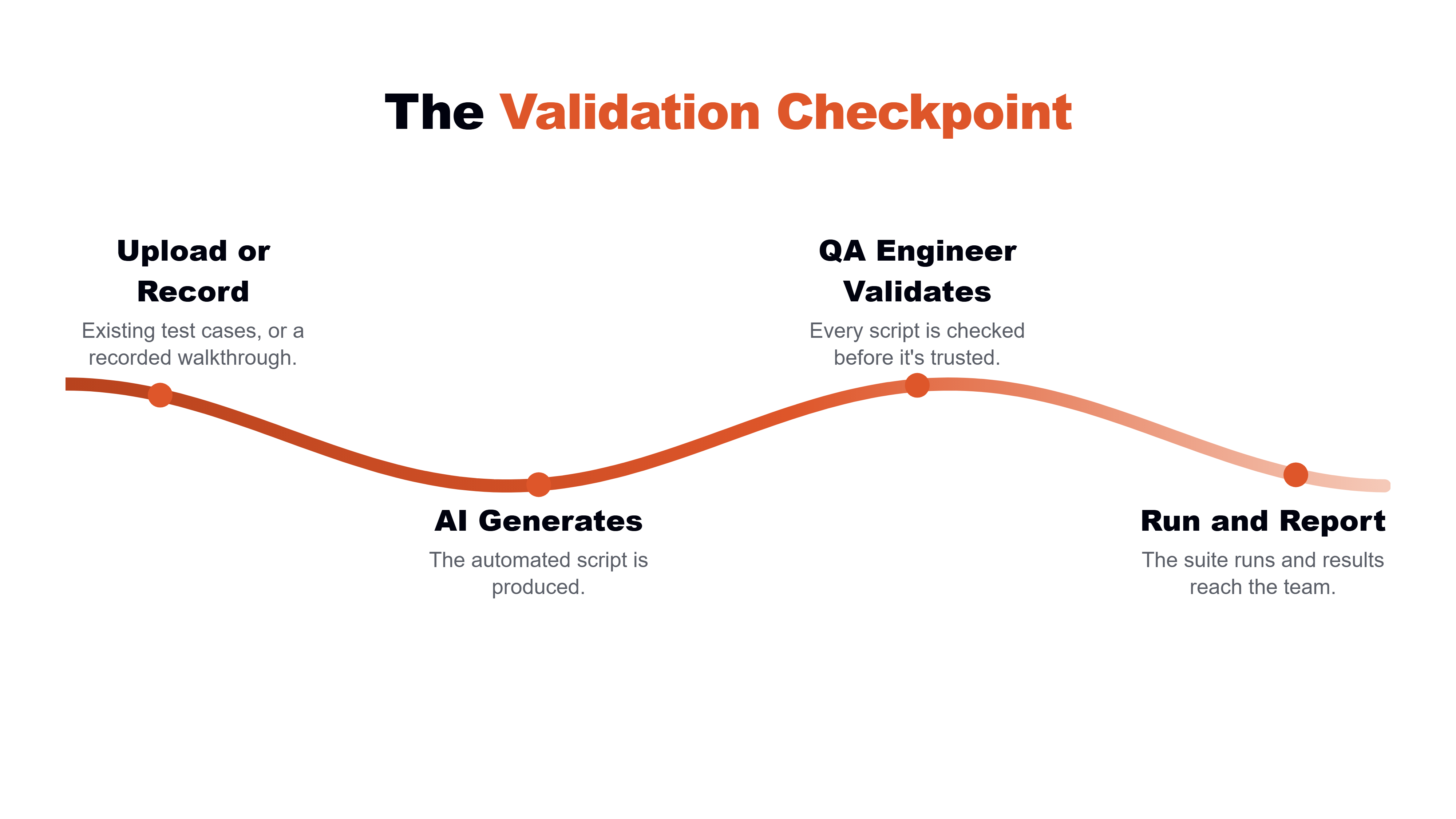
That combination, AI generation paired with a named human checkpoint, is part of a wider shift already reshaping how AI is changing the QA lifecycle.
Claim a $0 Testing Sprint and get one test case automated, engineer-validated, and running at no cost. Prefer a number first? Get your estimate.
A 30-Day Pilot Proves Whether an Outsourced QA Vendor Delivers
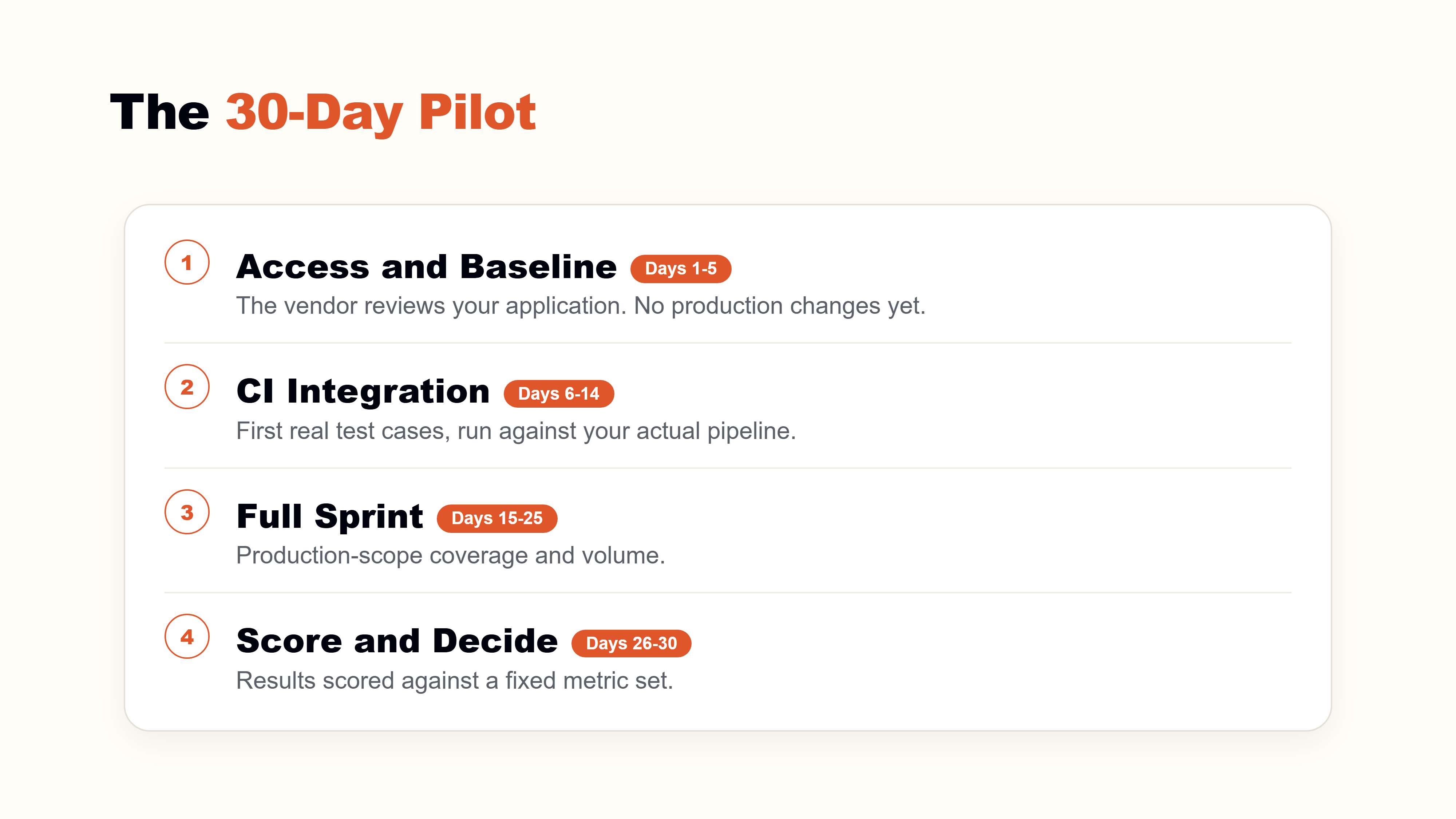
A vendor's claimed numbers are a starting point. A structured 30-day pilot turns those claims into something you can actually check, against Qadence or any other vendor under consideration.
- Days 1-5. Access and baseline only. The vendor reviews your application and existing test cases, and no production changes happen yet.
- Days 6-14. CI integration and the first real test cases, run against your actual pipeline rather than a sandbox.
- Days 15-25. A full sprint at production scope, covering the coverage and volume you'd actually run week to week.
- Days 26-30. Score the results against a fixed metric set and decide, using the same table you'd use to compare any other vendor.
SLA Clauses to Require in Any Outsourced QA Testing Contract
- Defect escape rate, measured against your current baseline, not an abstract industry average.
- Turnaround time on a failed run, stated in hours, not left as "as soon as possible."
- Coverage delivered, tied to the scope agreed at kickoff, not a rolling target that moves.
- Exit and data-portability terms, specifying exactly what you keep if the engagement ends.
- Named-engineer continuity, with a defined notice period before any account reassignment.
Any vendor worth evaluating should clear a pilot like this without flinching, and should treat these five clauses as a normal part of contracting rather than a negotiation to resist.
A vendor that pushes to skip straight to a full engagement is telling you something. So is a vendor that offers only a curated demo instead of a pilot against your own application and your own baseline.
Qadence's own onboarding, live in under 24 hours from the first call, is one data point worth holding any vendor's Day 1-5 claim against.
Verify Any Outsourced QA Vendor Before You Commit Budget
The decision runs through four checks. Whether your situation matches one of the three fit signals, which of four models fits it, and whether the vendor in front of you survives the four failure modes and a real 30-day pilot. AI-generated code has already changed the first question. A VP of Engineering evaluating outsourced testing in 2026 still has to answer the rest with evidence, not a vendor's own claims.
Claim a $0 Testing Sprint: one AI-generated, engineer-validated test case automated at no cost, with dashboards showing the gains and a business case built around your own application. Prefer a number first? Get your estimate.
References
[1] SmartBear, "AI Software Quality Gap Report." https://smartbear.com/ai-software-quality-gap-report/
[2] CircleCI, "5 key takeaways from the State of Software Delivery Q2 Pulse report." https://circleci.com/blog/five-takeaways-2026-q2-pulse/
[3] The Business Research Company, "Outsourced Software Testing Services Global Market Report." https://www.thebusinessresearchcompany.com/report/outsourced-software-testing-services-global-market-report
[4] Forrester, "The Forrester Wave: Autonomous Testing Platforms, Q4 2025." https://www.forrester.com/blogs/the-autonomous-testing-platform-wave-q4-2025-is-out/
[5] Consortium for Information and Software Quality (CISQ), "The Cost of Poor Software Quality in the US: A 2022 Report." https://www.it-cisq.org/the-cost-of-poor-quality-software-in-the-us-a-2022-report/
[6] DEV Community, "What we learned running a QA outsourcing company for 8 years." https://dev.to/tudorsss-betterqa/what-we-learned-running-a-qa-outsourcing-company-for-8-years-557n
[7] Capgemini, "World Quality Report 2025: AI adoption surges in Quality Engineering, but enterprise-level scaling remains elusive." https://www.capgemini.com/us-en/news/press-releases/world-quality-report-2025-ai-adoption-surges-in-quality-engineering-but-enterprise-level-scaling-remains-elusive/