

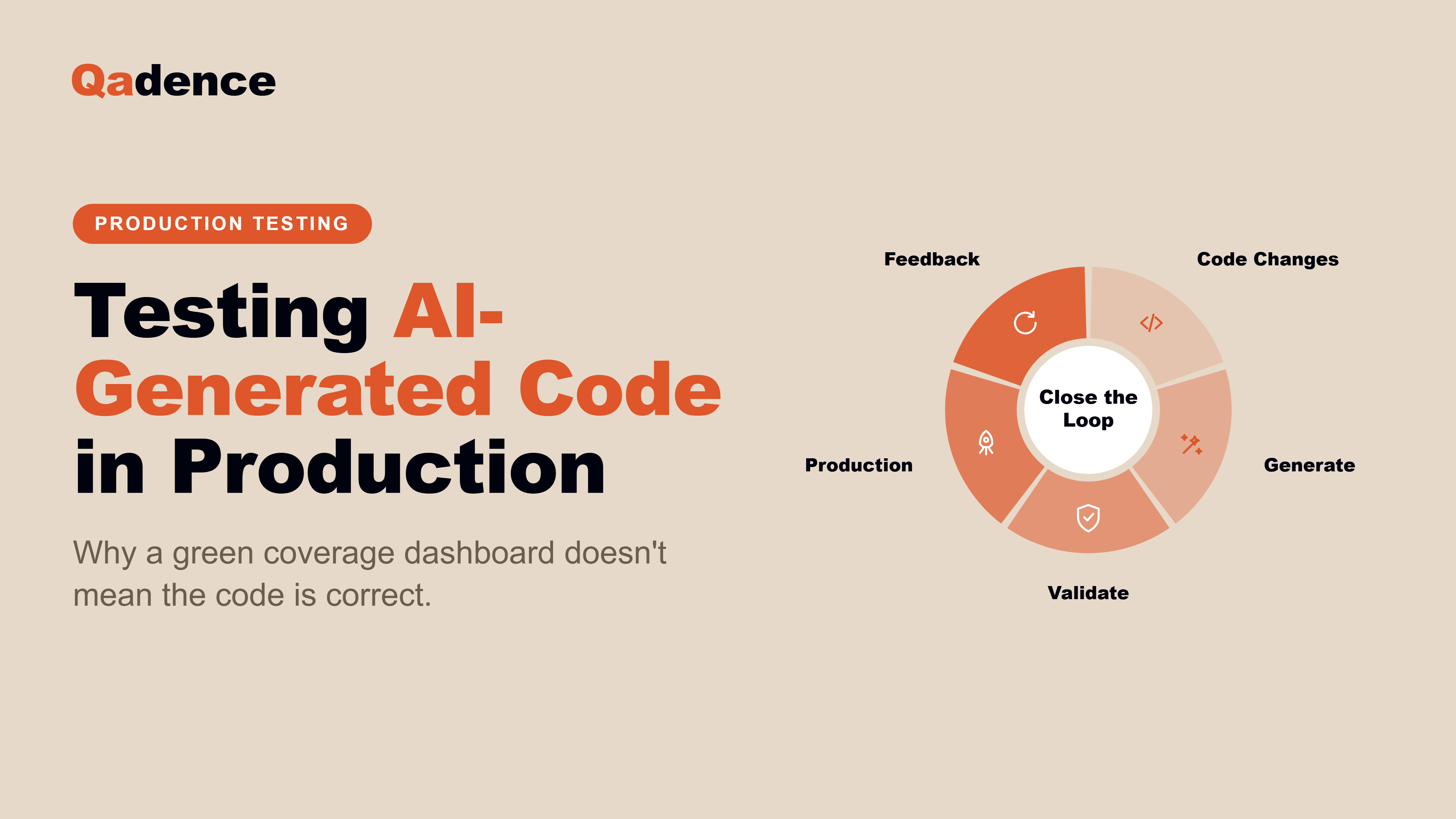
TL;DR (Executive Summary)
- Coverage doesn't predict incidents. 80% of organizations have traced a production incident to AI-generated code in the past year, even though most of that code passed testing and shipped with a green build.
- AI-generated code fails through four specific patterns. Silent assumption propagation, integration surface mismatches, domain edge case blindness, and CI noise that teaches engineers to ignore real failures.
- A test written by the same system that wrote the code isn't independent verification. When the oracle and the implementation share an author, a passing suite confirms consistency, not correctness.
- Three architectural requirements actually close the gap. Change-aware test generation at the diff level, domain-sourced test expectations, and production feedback that updates what gets tested next.
- A validated model produces audit evidence as a byproduct, not a separate project. Traceability comes from the same human-checkpoint step that catches a bad generation in the first place.
Testing AI-generated code in production has become one of the sharpest gaps between what a coverage dashboard reports and what actually reaches customers. Eighty percent of organizations have traced a production incident back to AI-generated code in the past twelve months, and most of that code passed its tests before it shipped [1].
A green coverage number was never proof that code is correct. It only proves that tests exist and pass, and when those tests come from the same system that wrote the code, passing them proves less than most QA Managers assume.
Coverage measures whether a test exists and passes, not whether it was built independently of the code it checks. AI-generated code fails through different patterns than human-written code. It silently carries forward assumptions nobody stated.
It passes in isolation while breaking at integration boundaries, and it handles the common path well while missing the domain-specific case a human reviewer would have caught. Closing that gap takes a specific kind of testing architecture, not just more tests.
Production Incidents Are Already Rising
The scale of the disconnect is documented in a 2026 survey of 400 business and engineering executives. 83% report that more than 10% of their production code is now AI-generated, and 28% report more than a quarter of it is [1].
53% say they sometimes or frequently ship with unresolved testing issues, and 66% say they've compromised quality or testing standards to hit a deadline.
The gap between the stated goal and the actual habit is specific. 61% of the same organizations test AI-generated code with AI tools at least sometimes, but only 6% do so consistently [1]. AI code needing different scrutiny is common knowledge by now. Building that scrutiny into an actual routine is rarer.
Industry-wide adoption tells a similar story. 89% of organizations are piloting or deploying gen-AI-augmented quality engineering workflows, but only 37% have it in production and just 15% have reached true enterprise scale [2].
That gap between piloting and actually operating at scale is the same gap driving broader AI-augmented testing adoption trends industry-wide. Generating AI code has outpaced verifying it, across most organizations in this data.
A separate 2025 survey of 1,500 QA professionals found 82% believe AI skills will be critical to their role within three to five years. 61% are already adopting AI-driven testing to automate repetitive work [3].
The adoption curve is real, and the intent behind it is genuine. It just hasn't caught up yet to the specific coverage gap it's supposed to close.
AI-Generated Code Fails in Four Ways
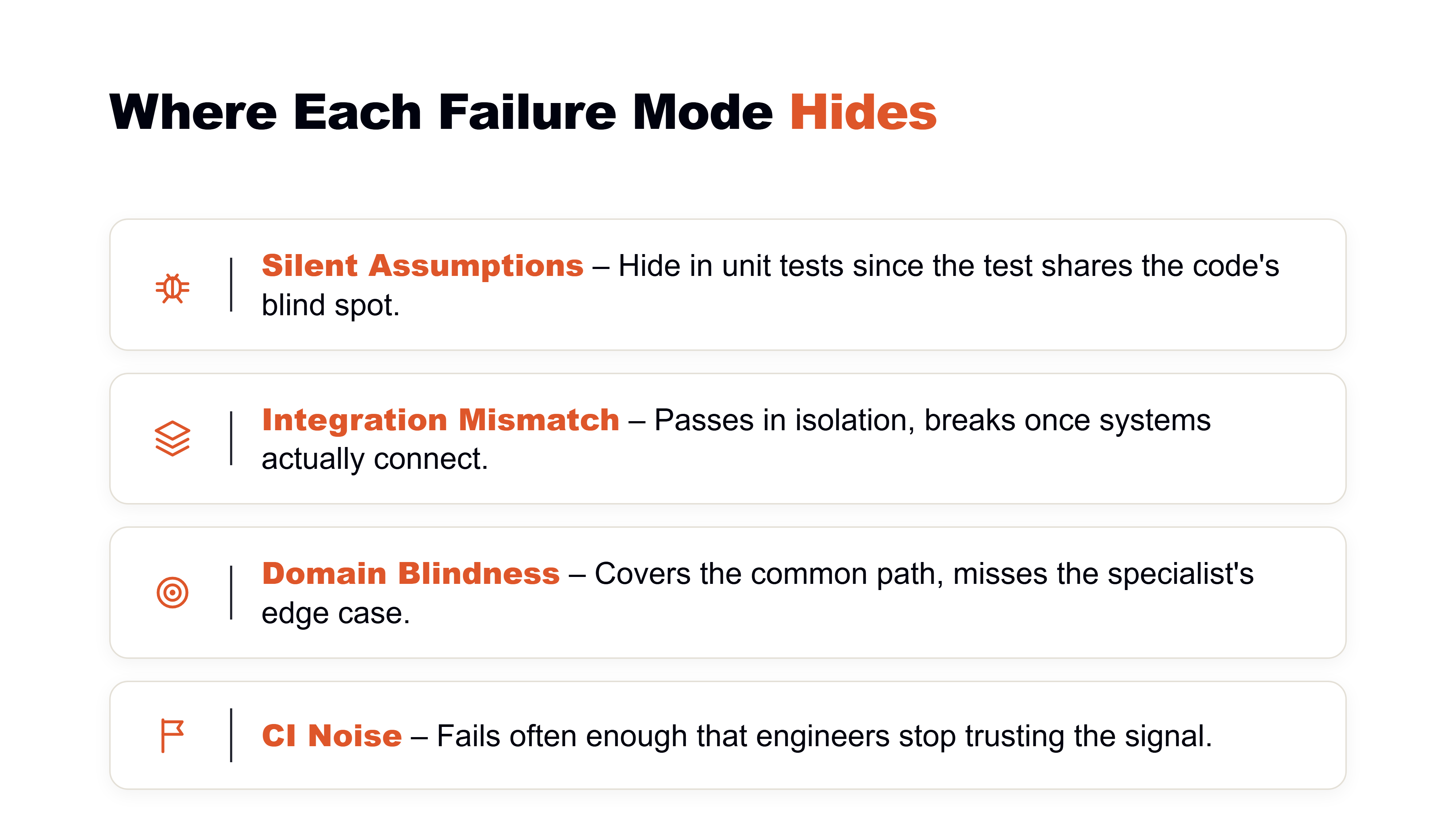
Four failure patterns account for most of the gap between a passing test suite and a real production incident.
Silent assumption propagation. AI-generated code often carries forward an assumption the original prompt never stated. Nothing in a typical test catches it, because the test was usually generated from the same code carrying the same assumption. A test built this way confirms the code is internally consistent. It does not confirm the code is correct, since the oracle and the implementation share the same blind spots.
One documented pattern: a billing service passed staging and CI cleanly, then failed in production on a leap-year-anniversary date calculation the original prompt never mentioned. The generated tests never constructed that case, because nothing asked them to.
Integration surface mismatch. A test that passes in isolation can still break at a real system boundary the test never modeled. AI-generated code shows this pattern at a measurably higher rate than human-written code.
An analysis of real pull requests found AI-generated code carries roughly 1.7 times more defects overall than human-written code, evaluated against actual repositories rather than synthetic benchmarks [4]. Isolated unit coverage does not catch a mismatch that only appears once two systems actually talk to each other.
Domain edge case blindness. AI handles the common path well and tends to miss the domain-specific condition a specialist would flag on sight. Security testing shows this unevenness clearly.
Across a large 2026 benchmark of AI coding models, cross-site scripting defenses passed only 15% of the time and log injection defenses just 12%. The same models handled SQL injection and cryptographic tasks at 83% and 87% respectively [5].
One recurring pattern outside security specifically: a multi-device healthcare form passed its automated regression suite cleanly. It still left patient data cached unencrypted on a device when a clinician switched devices under low bandwidth, a condition the original test suite was never built to check.
CI noise and alert fatigue. A pipeline that fails often enough, for reasons that turn out not to matter, teaches engineers to stop trusting it. Once a team starts re-running a failed build instead of reading why it failed, the pipeline has stopped doing its job even while it keeps producing a signal.
That erosion compounds the first three failure modes rather than sitting apart from them, since a backlog of low-trust CI failures is the same feedback-latency problem driving QA backlogs more broadly.
A Self-Assessment for Your Coverage
Six questions separate a testing approach that's actually closing this gap from one that only looks like it is.
A team that answers "common gap" on three or more of these is carrying more risk than its coverage dashboard shows.
Three Requirements for AI-Era Testing
Testing has to become change-aware, generated at the diff level rather than from a static suite that ages the moment the code around it changes. Meta's own research on just-in-time test generation makes the case concretely.
Tests generated by analyzing a code diff directly, rather than hardening whatever already passes, caught roughly four times more real bugs than baseline generated tests. Measured against coincidental catches specifically, the improvement reached up to twenty times, across an evaluation of more than 22,000 generated tests [6]. The shift is from tests that confirm today's code to tests built to catch tomorrow's failure.
Test expectations have to come from somewhere other than the implementation itself. A test generated from the same code it checks inherits that code's blind spots by construction, which is the direct explanation for silent assumption propagation.
Sourcing expected values from an independent specification, a domain rule, or a human reviewer's judgment breaks that shared-author problem, and it's the same requirement the self-assessment above is actually testing for.
Testing has to close the loop with production instead of stopping at deployment. A failure mode that only shows up in production, the way most of the four failure modes above do, needs to feed back into what gets generated and tested next.
Without that feedback loop, a team's test suite optimizes for what already happened rather than for what production keeps proving is actually missing.
How Qadence Meets These Requirements
Qadence answers the second requirement directly. A team uploads existing test cases or records a walkthrough once, and AI generates the automated script. A QA specialist reviews and validates every generated script before it's trusted, the same way a senior engineer reviews a pull request.
That validation step is an independent check by construction, since the person confirming the test is not the system that wrote the code being tested.
Self-healing scripts answer the first requirement in practice. A script built on brittle, literal locators breaks on almost any interface change. A role-based, user-facing locator built to track intent survives the same change and keeps testing the actual behavior rather than a snapshot of yesterday's markup.

The scale effect follows the same pattern seen across manual-to-AI-plus-specialist comparisons generally. A 30-person manual QA team's output is now commonly matched by roughly a 10-person team paired with this kind of platform. A team of 3 QA engineers can be replaced by 1 engineer working alongside the platform, without losing coverage.
See what an independently validated test actually catches on your own codebase.
Claim a $0 Testing Sprint for one test case, automated and specialist-reviewed at no cost, or get your estimate scoped to your current coverage gaps.
Compliance and Audit Trail Evidence
A green coverage number was never audit evidence. 76% of teams now catch more compliance issues after deployment than during development, because auditors ask for test traceability, not a passing build.
An auditor working against SOC 2, HIPAA, or a similar framework asks a more specific question: what was tested, by whom, and when, with a record that survives scrutiny after the fact. A manual QA process that has never had to produce that record for an outside auditor typically discovers the gap during the audit itself, which is an expensive time to discover it.
A validated model produces that record as a byproduct of the same step that already has to happen anyway. Every generated script gets a named specialist's review before it ships, and that review is itself the traceable event an auditor is looking for: what was tested, who confirmed it, and when.
The evidence doesn't require a separate documentation sprint bolted on afterward, because the human checkpoint that catches a bad generation is the same event that produces the record.
Closing the Coverage Gap
A coverage percentage was never proof that AI-generated code is correct in production, only proof that a test exists and passes. 80% of organizations have already traced a production incident back to AI-generated code despite that number staying green [1].
Closing the actual gap takes tests built independently of the code they check, generated at the pace the code changes, and fed by what production keeps proving is still missing.
Testing AI-generated code in production, the way this piece defines it, is the specific architecture a QA Manager needs before the next incident report shows up with a passing test suite attached to it.
Claim a $0 Testing Sprint: one AI-generated, specialist-validated test case automated at no cost, with a report showing exactly what independent validation catches on your own application. Prefer a number first? Get your estimate.
References
[1] Sauce Labs (via Wakefield Research, reported by DevOps.com), "Survey Surfaces Rising Tide of Production Issues Traced Back to AI Code." https://devops.com/survey-surfaces-rising-tide-of-production-issues-traced-back-to-ai-code/
[2] Capgemini, "World Quality Report 2025." https://www.capgemini.com/us-en/news/press-releases/world-quality-report-2025-ai-adoption-surges-in-quality-engineering-but-enterprise-level-scaling-remains-elusive/
[3] Katalon, "State of Software Quality Report 2025." https://katalon.com/resources-center/blog/2025-state-of-software-quality-report
[4] CodeRabbit's "State of AI vs Human Code Generation" findings, via Shiplight, "AI-Generated Code Has 1.7x More Bugs." https://www.shiplight.ai/blog/ai-generated-code-has-more-bugs
[5] Veracode, "2026 GenAI Code Security Report." https://www.veracode.com/blog/2026-genai-code-security-report-ai-risk/
[6] Meta, "Just-in-Time Catching Test Generation at Meta." https://arxiv.org/abs/2601.22832