

TL;DR (Executive Summary)
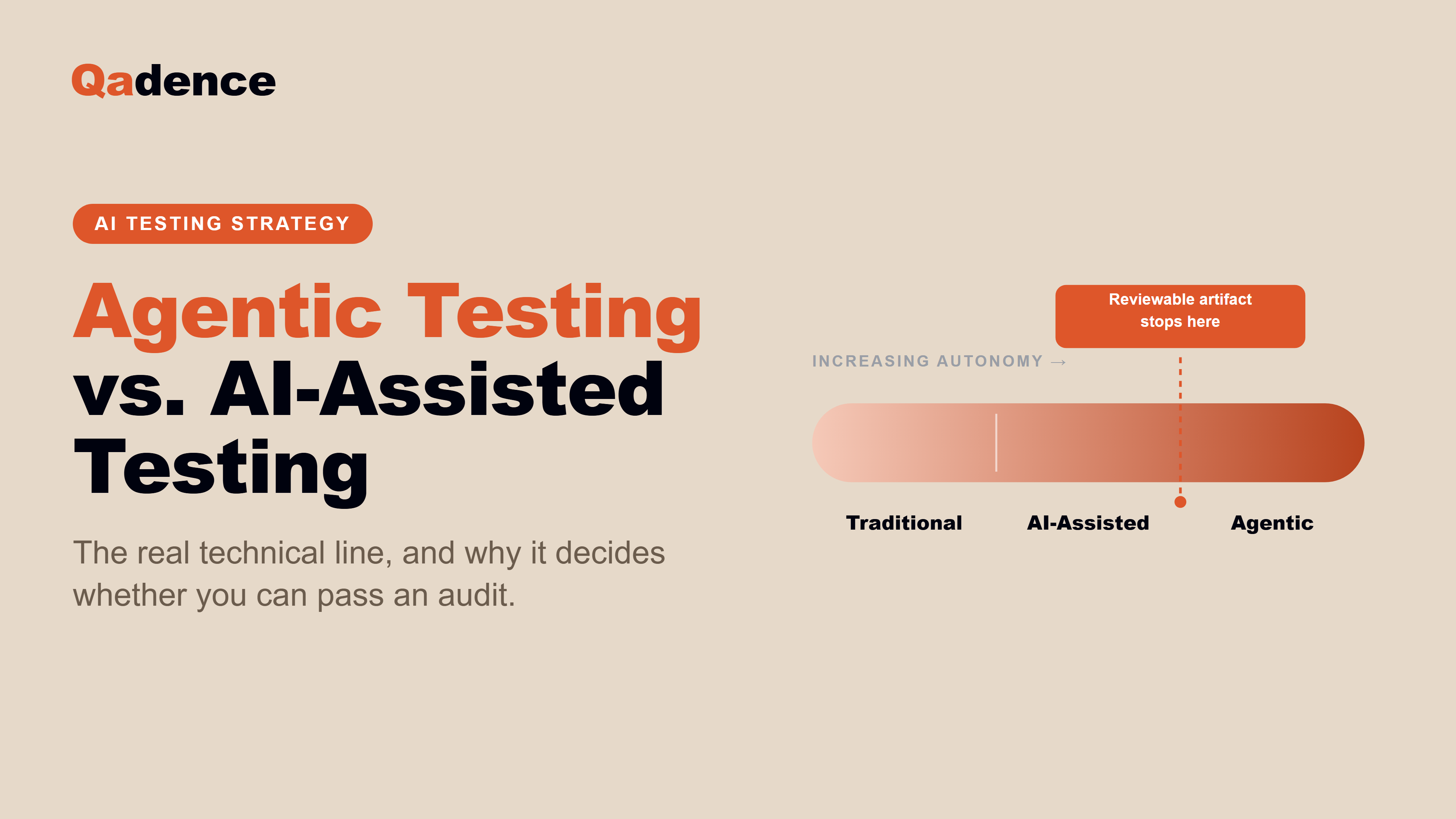
- Agentic and AI-assisted testing are genuinely different categories. AI-assisted testing helps a person write or maintain a fixed script. Agentic testing runs a test at execution time from a natural-language goal, with no fixed script left behind.
- Self-healing counts as AI-assisted automation. A script that patches a broken locator but still runs the same steps every time.
- What gets left behind after a run matters more than the label a vendor uses. A fixed script is something a person can check before it runs again. A runtime trace usually leaves nothing to check.
- That distinction decides whether a regulated team can pass an audit on its own test evidence.
Agentic testing and AI-assisted testing get used almost interchangeably. 84% of developers now use or plan to use AI tools in their work, up from 76% a year earlier [1]. CI/CD throughput is up 59% year over year, but main-branch success rates have fallen to 70.8%, a five-year low, and average recovery time after a broken build is now around 72 minutes [2].
Writing code stopped being the constraint. Validating it is. That pressure is why "agentic testing" became a term everyone uses and few define the same way. Two vendors can both call their product "agentic" and mean different things, and the sales deck won't tell you which.
This piece draws the line that actually holds and gives you a concrete test for any vendor's claim.
The same throughput mismatch is already clearing out QA backlogs elsewhere in the pipeline.
Vendors Don't Agree on What Agentic Testing Means
AI-assisted testing uses AI to help a person write or maintain a test script that still exists as a fixed set of steps. Agentic testing uses an AI agent that plans, executes, and adapts a test at runtime from a natural-language goal, with no fixed script underneath.
Vendors haven't converged on where the line sits. One competitor's own published framework treats agentic and AI-assisted testing as genuinely separate categories, and excludes self-healing from agentic territory entirely.
A separate managed-testing competitor's own tools roundup splits "agentic" into two sub-types by what a run actually produces: portable, deterministic code, or a non-repeatable execution.
Two competitors, writing independently, landed on the same fracture point. The market hasn't agreed on what "agentic" means as a label. What a tool actually produces at the end of a run is the more useful thing to check, especially for a buyer already comparing vendors.
Claim a $0 Testing Sprint and compare what your current suite produces against a fixed, ownable script.
The Technical Difference Between Agentic Testing and AI-Assisted Testing
Agentic testing and AI-assisted testing sit on opposite sides of a real technical line. AI-assisted testing uses AI to help a person write or maintain a fixed test script. Agentic testing uses an AI agent that plans, executes, and adapts a test at runtime from a natural-language goal, usually with no fixed script left behind.
That fixed script is what a person can review before it runs again. A fully agentic run usually leaves nothing behind to check.
An agentic test moves through the same four-step loop at runtime, regardless of vendor:
- Perceive: Read the current state of the application.
- Plan: Decide what action moves toward the stated goal.
- Act: Execute that action against the real, running application.
- Adapt: Re-perceive and re-plan if the result was unexpected, with no fixed script to fall back on.
Debugging works differently as a result. A scripted failure points to a specific line. An agentic failure points to a goal that didn't get met, and finding out why usually means replaying logs.
How Self-Healing Scripts Differ From Agentic Testing
Self-healing sits on the AI-assisted side of the line. A self-healing script runs the same steps every time. AI only patches a broken locator when the underlying element moves, and the result is still something a person can open and read.
That distinction matters because a locator-only fix can go wrong quietly. A selector-based match can lock onto a visually similar but wrong element after a real UI change, pass the test, and let a real regression ship.
One independent practitioner puts it plainly: self-healing that papers over an unflagged change is "nothing more than band-aids, hiding the real problem that is underneath" [3]. Once a suite is known to produce a false green, engineers stop trusting it.
Why a Fixed Test Script Matters for Compliance and Audits
This distinction matters more once a regulated buyer is involved. Non-deterministic execution is already a named compliance concern in AI governance generally. Audit-grade trails are a byproduct of deterministic execution, because a system that replans its own steps every run leaves no stable artifact for an auditor to check later.
Even a vendor built around the agentic category admits this. One competitor's own published content concedes that a fully agentic approach isn't yet a fit for highly regulated systems that require reproducibility and transparency, and points to a future human-oversight role as the eventual fix.
This shows up in real compliance data. Compliance teams commonly catch more issues after deployment than during development, and auditors increasingly ask for test traceability, since a green checkmark alone doesn't hold up as evidence.
That gap lands directly on a QA Manager's own numbers, since defect escape rate and audit findings are usually tracked against the same suite. A fixed script that a QA engineer signed off on still counts as evidence months later, when an auditor asks for it.
Claim a $0 Testing Sprint and see what audit-grade documentation looks like on your own application, or get your estimate for the full picture.
How Qadence Combines AI-Generated Scripts With Engineer Validation
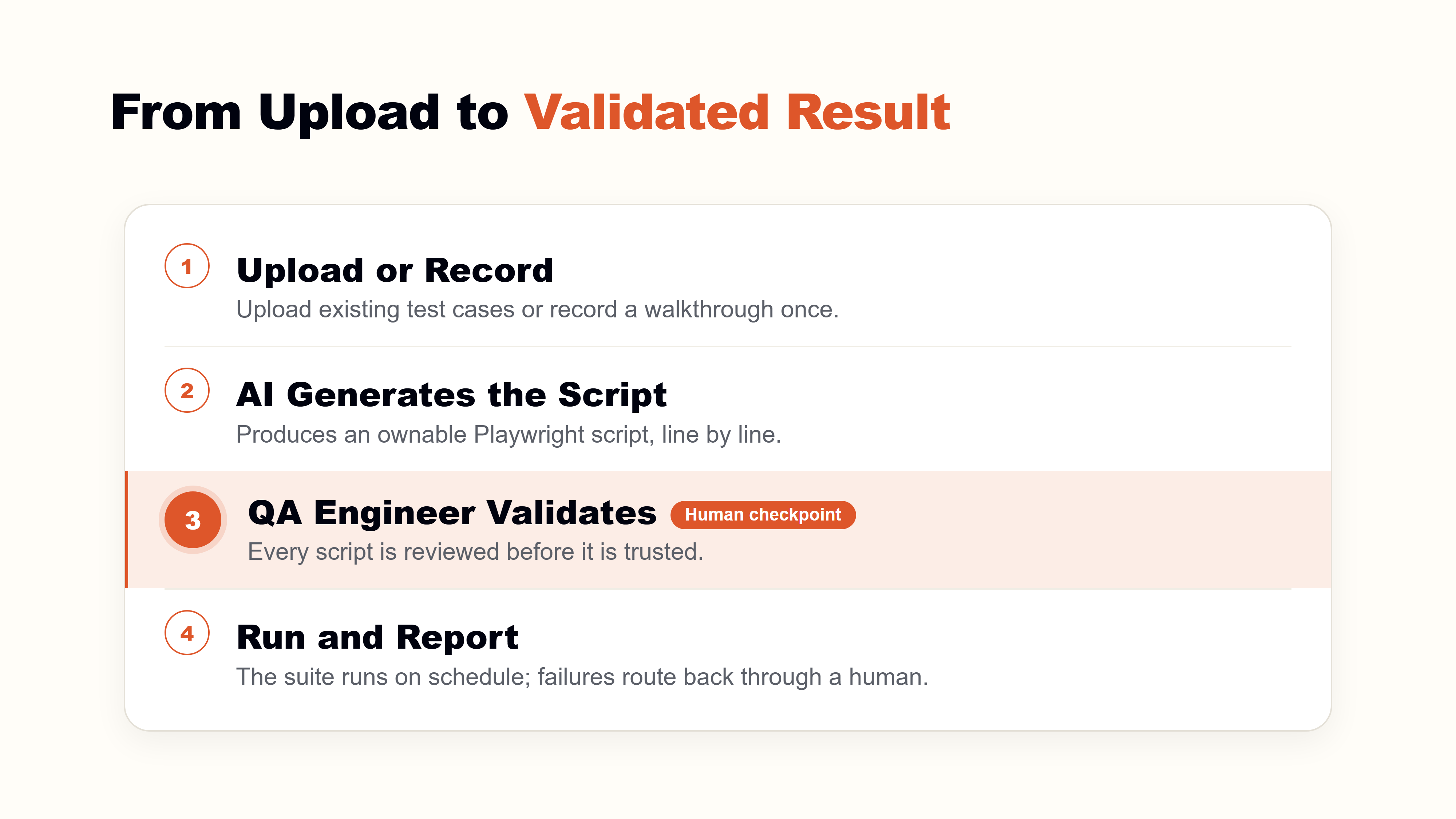
Qadence is built deliberately on the artifact-plus-validation side of this line. A test gets created one of two ways: upload existing test cases, or record a walkthrough once with Qadence's own recorder. Either path produces an ownable, production-ready Playwright script the client can inspect line by line.
Every AI-generated script is reviewed by a QA engineer before it's trusted. A failed test is human-confirmed before a Jira ticket is created. That validation gate is the direct answer to whether AI is replacing QA engineers. The platform replaces the manual scripting work, and a QA engineer still signs off on every result.
The loop runs the same way every cycle: upload or record, AI writes the script, an engineer validates it, the suite runs on schedule and reports results. Self-healing removes the maintenance tax that breaks a large share of automated suites industry-wide, and the human checkpoint stays in place around it.
That mix of generation and a human check is part of a wider shift already reshaping how AI is changing the QA lifecycle.
Three Questions to Ask Any Agentic Testing Vendor
The category label a vendor uses matters less than what its answers reveal here.
- Does this produce a fixed script I can review, or only a runtime trace? If only the second, ask what gets checked before that run is trusted.
- Who signs off before a failure becomes a ticket, and how? A specific answer names a person and a step. A vague answer names a philosophy.
- What would an auditor see six months from now? A saved, reviewable artifact is evidence. A general description of the agent's behavior does not hold up the same way.
A vendor with clear answers to all three has a real validation model behind the marketing term. A vendor without one is asking for trust it hasn't earned.
Conclusion
Vendors will keep using "agentic" to mean different things. The category label matters less than what a tool leaves behind. Either a script you can check, or a trace that disappears once the run ends. Check for the artifact before you trust the claim.
See this on your own application. Claim a $0 Testing Sprint or get your estimate.
References
[1] Stack Overflow, "2025 Stack Overflow Developer Survey." https://survey.stackoverflow.co/2025/ai
[2] CircleCI, "2026 State of Software Delivery." https://circleci.com/resources/2026-state-of-software-delivery/
[3] Bas Dijkstra, "My thoughts on self-healing in test automation," ontestautomation.com. https://www.ontestautomation.com/my-thoughts-on-self-healing-in-test-automation/