

TL;DR (Executive Summary)
- Hiring lags by design. QA engineers take 11 to 14 weeks to hire and cost $150,000 to $220,000 fully loaded per person, while release volume keeps climbing without pause.
- More heads is not more speed. Headcount scales in steps; AI-driven release volume scales continuously, so hiring never closes the gap it is meant to close.
- Legacy outsourcing solves the wrong problem. Offshore and staff-augmentation models add labor, not judgment, so the same velocity mismatch persists under a different invoice.
- Generation without validation is not coverage. AI can write test cases fast, but coverage only holds up when a specialist checks every result before a team relies on it.
- The economics flip once headcount stops gating coverage. Per-test-case pricing with volume discounts scales differently than either a salary or an hourly outsourcing bill.
Outsourced QA services are back in the conversation at most mid-market software companies in 2026. AI tools now write a meaningful share of the code shipping through engineering organizations, and release volume keeps climbing as a result, while QA hiring has not kept pace.
A company weighing outsourced QA services today is really choosing between two structurally different approaches. One keeps adding QA engineers one hire at a time. The other brings in a service where AI generates test coverage at the pace code ships, and a QA specialist validates every result before it is trusted.
For most mid-market teams, the second approach wins. Hiring lags release velocity by design: each QA hire takes 11 to 14 weeks to land and costs $150,000 to $220,000 fully loaded, while release volume keeps climbing regardless. A validated AI-plus-specialist model scales coverage without adding headcount, and unlike legacy offshore outsourcing, keeps a named engineer accountable for every result.
AI Has Outpaced QA Hiring
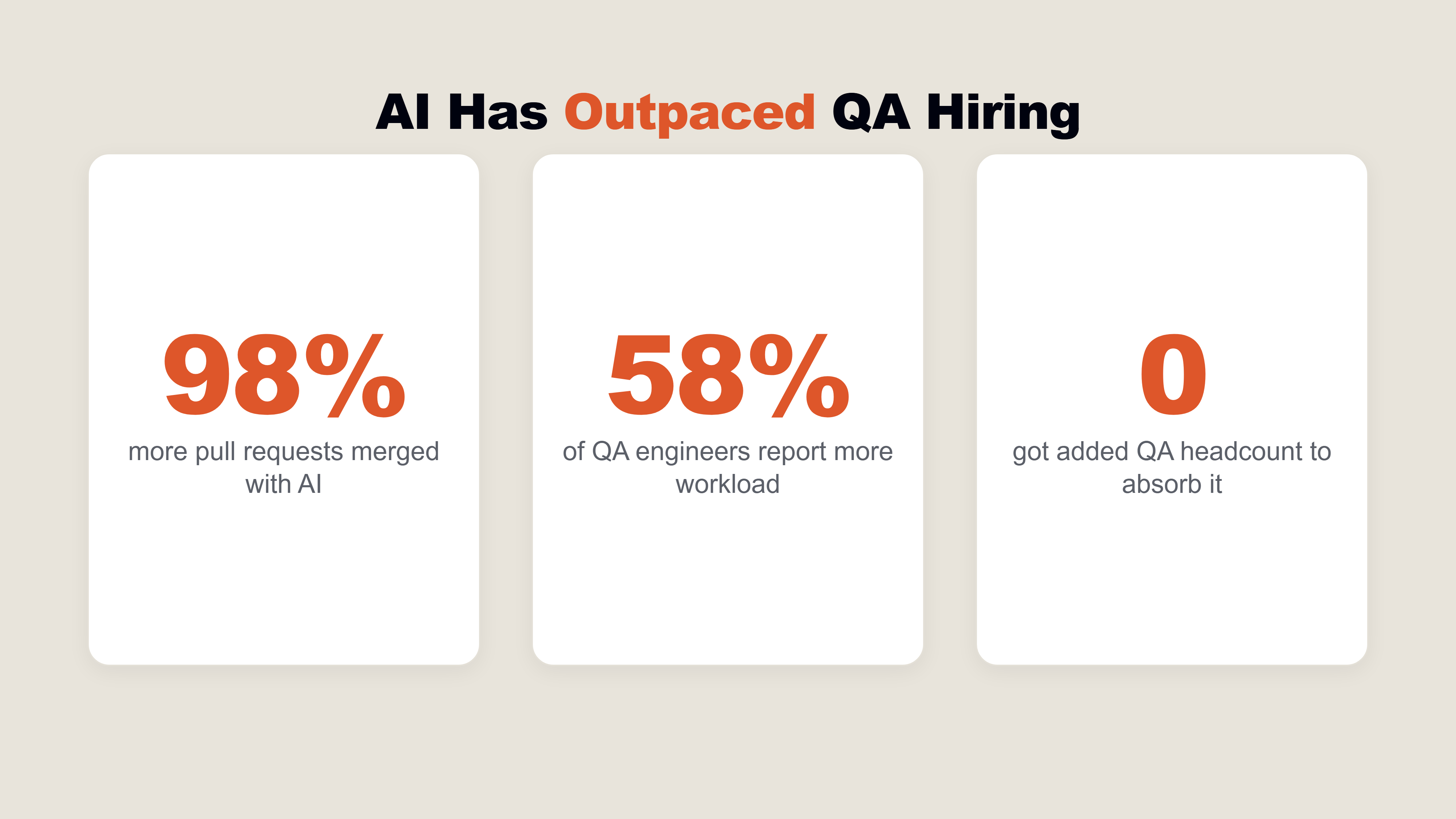
The imbalance shows up clearly in recent survey data. DeviQA's 2026 survey of QA engineers working alongside AI-adopting development teams found that AI-assisted teams merge 98% more pull requests than teams without AI tools, and developers complete 21% more tasks overall [1].
QA headcount did not move to match. 58% of QA engineers in the same survey reported increased testing workload since AI adoption began, and not a single respondent reported receiving additional QA headcount to absorb it.
The broader market is responding to the same pressure from a different angle. The software testing and QA services market is valued at $50.67 billion in 2026, growing at 11.5% a year, largely because organizations are looking outside their own hiring pipelines for coverage [2].
QA-specific strain compounds further in the same survey: review times are up 91% for AI-adopting organizations, and AI-authored pull requests wait 4.6 times longer for reviewer attention than human-written ones [1].
The pattern holds beyond QA specifically too. Bugs per developer climbed 54% in AI-adopting engineering organizations broadly, more than five times the prior year's 9% increase [3]. Verification capacity is not scaling at the rate of the work that needs verifying, which is a different and more specific problem than a missing headcount line in next year's budget.
This is the same underlying pattern behind most QA backlogs: the bottleneck is feedback latency, not a missing headcount line.
QA Hiring Does Not Scale With Release Velocity
Hiring costs real money and takes real time. A senior QA engineer's base salary in the US typically runs $116,834 to $170,000, and base salary was never the number that mattered most [4][5].
Benefits alone run 30 to 40% of base. Add recruiting fees of 15 to 25% of first-year salary and tooling costs, and the fully loaded cost of one senior QA hire lands at roughly $150,000 to $220,000 a year [4]. One widely cited framing from a 2026 hiring-cost analysis puts it plainly: a $90,000 offer letter is really closer to a $180,000 budget decision once the full cost is counted [4].
Cost is only half the constraint. The hiring timeline itself runs 11 to 14 weeks on average, from opening the role to a signed offer, before onboarding and ramp time even start. A team that decides today it needs more QA coverage will not have that coverage for a full quarter, and the release volume that created the need in the first place will not wait.
The deeper issue is structural. Hiring adds capacity in steps: one engineer, then a multi-month gap, then the next. Release volume under AI-accelerated development does not move in steps.
It climbs continuously, sprint over sprint, as more code gets written and merged. A step function cannot keep pace with a continuous curve no matter how many steps a company is willing to fund. Hiring is a legitimate response to a one-time capacity shortfall.
A demand curve that keeps climbing quarter over quarter needs a different mechanism, one that does not require a new person, a new desk, and a new ramp period every time it climbs again.
Legacy QA Outsourcing Adds Labor, Not Judgment
Outsourced QA still means, to a lot of buyers, the traditional model: offshore or nearshore staff augmentation, billed hourly or by seat. That model is real, it is common, and it solves a real problem, namely finding enough hands to run tests. It does not solve the problem this piece is actually about.
Traditional outsourcing adds labor, not judgment. A vendor supplies testers who follow direction. Rates typically range from $15 to $50 an hour offshore up to $75 to $180 an hour onshore, or a retainer commonly running $5,000 to $50,000 or more a month. None of that changes who owns the outcome, and it does nothing to change the fact that release volume is still climbing faster than any team, internal or contracted, can manually keep up with.
The failure patterns are well documented and consistent across the category:
A company that swaps internal hiring for this model has changed who sends the invoice. It has not changed the mechanism.
AI Generates Coverage, Specialists Validate It
A different model has emerged that is neither of the above. It generates test coverage with AI, at whatever pace the codebase is actually changing, and it validates every result with a QA specialist before a team is asked to trust it. That second half is not optional. Coverage that skips validation is not coverage a CTO can actually rely on when it matters.
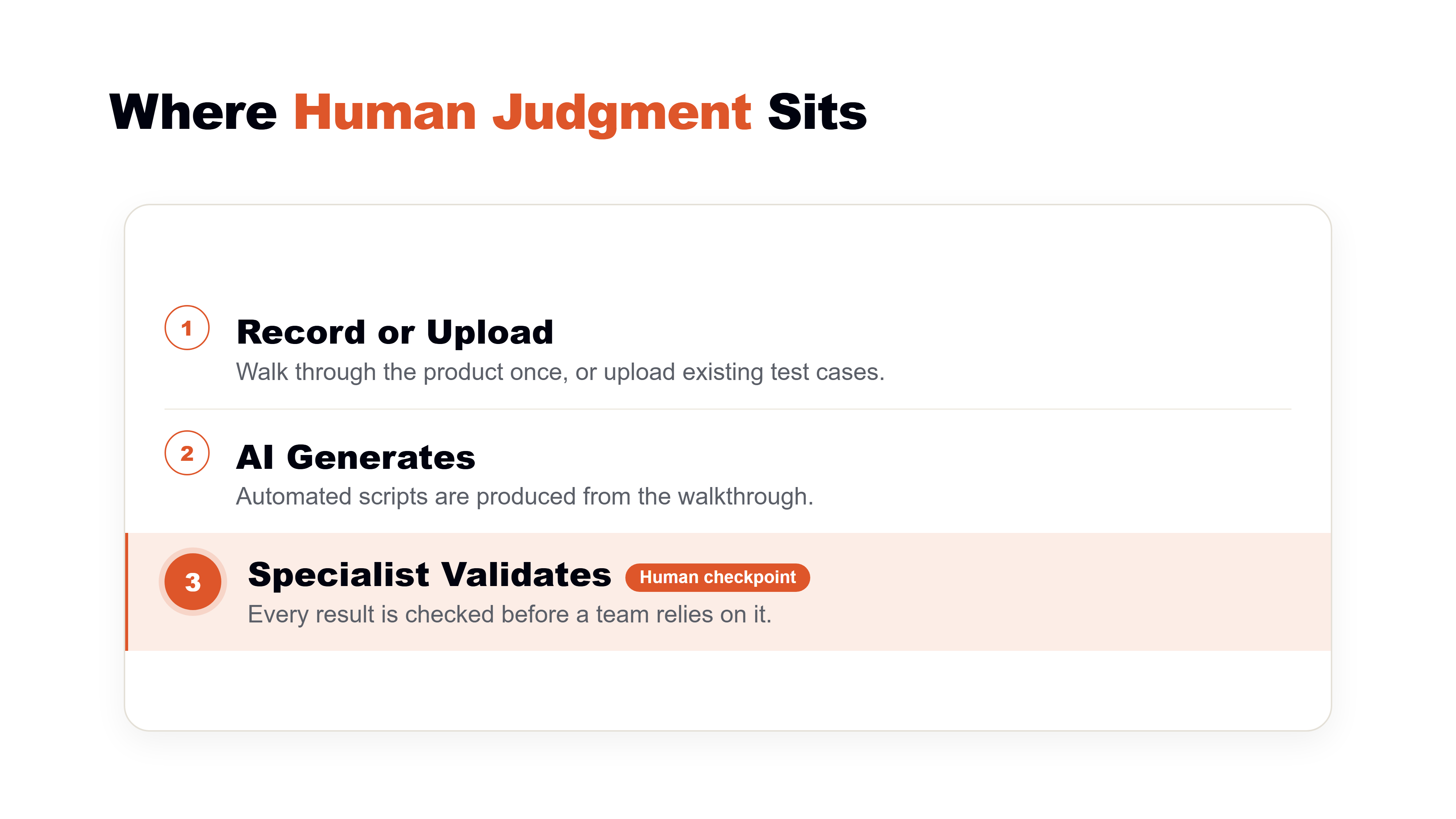
The mechanism is straightforward. A team uploads existing test cases or walks through a live product flow once, and a recorder captures every step. AI generates the automated test scripts from that walkthrough.
A QA specialist then reviews and validates each generated script before it goes live, the same way a senior engineer reviews a pull request. That means checking logic, edge cases, and whether the script actually tests what it claims to test. The human owns the outcome, and every generated script is validated before a team is asked to trust it.
Onboarding under this model is live in under 24 hours from the first call, not the 11 to 14 weeks a new hire requires. That speed exists because generation is not gated by hiring. Adding coverage does not require finding, interviewing, and training a new person; it requires pointing the system at the next part of the application.
The scale effect compounds from there. A 30-person manual QA team's total output is now commonly matched by roughly a 10-person team paired with this kind of platform, without cutting corners on coverage.
This kind of AI-plus-specialist testing is also where the broader industry is visibly heading, even if most organizations have not fully arrived. Capgemini's 2025 World Quality Report found that 89% of organizations are now piloting or deploying gen-AI-augmented quality engineering workflows, but only 15% have reached true enterprise-scale deployment [6].
The gap between those two numbers is largely a validation gap. Plenty of teams can generate AI test coverage; far fewer have a real process for confirming it is trustworthy before they rely on it. That is the same dynamic driving broader AI-augmented testing adoption trends industry-wide, and a validated service model is built to close that specific gap.
Comparing the Cost of Hiring, Outsourcing, and Qadence
Put the three approaches side by side and the shape of the decision gets easier to see.
The third column is the one worth sitting with. A per-test-case model with unlimited runs means the cost of running a test again, on the tenth release or the hundredth, does not climb the way a per-run vendor's meter does. And because coverage is not tied to a hiring pipeline, adding coverage for a new part of the product does not require a new person to do it.
See this cost comparison hold up against your own application. Claim a $0 Testing Sprint for one test case, automated and engineer-validated at no cost, or get your estimate scoped to your current QA spend.
Outsourced QA Services Scale With Release Velocity
Three approaches to outsourced QA services exist in 2026, and only one of them scales the way AI-accelerated release velocity actually demands. Hiring more QA engineers adds capacity in steps, at $150,000 to $220,000 fully loaded per step, against a demand curve that does not move in steps.
Legacy outsourcing changes who does the labor without changing whether judgment is applied to the result. A validated AI-plus-specialist model generates coverage at the pace code ships. It puts a specialist's judgment behind every result before a team relies on it, which is the mechanism this decision has always actually been about.
Release volume will likely double again before most hiring plans finish executing. Choosing the approach that keeps working at that volume matters more than choosing the one that looks cheapest this quarter.
References
[1] DeviQA, "State of AI-Generated Code 2026: The QA and Testing Gap." https://www.deviqa.com/blog/state-of-ai-generated-code-2026-the-qa-and-testing-gap/
[2] Coherent Market Insights, "Software Testing and QA Services Market." https://www.coherentmarketinsights.com/industry-reports/software-testing-and-qa-services-market
[3] Faros.ai, "The AI Engineering Report 2026: The AI Acceleration Whiplash." https://www.faros.ai/blog/ai-acceleration-whiplash-takeaways
[4] Minitap, "QA Engineer Fully Loaded Cost." https://www.minitap.ai/magazine/qa-engineer-fully-loaded-cost
[5] Underdog, "Your Guide to QA Engineer Salary Ranges in 2026." https://underdog.io/blog/qa-engineer-salary
[6] Capgemini, "World Quality Report 2025." https://www.capgemini.com/us-en/news/press-releases/world-quality-report-2025-ai-adoption-surges-in-quality-engineering-but-enterprise-level-scaling-remains-elusive/