

TL;DR (Executive Summary)
- Vendor pitches sound interchangeable on purpose. Generation, validation, and pricing get described in nearly identical language, so a generic sales call won't surface what actually differs.
- Onboarding timeline is the fastest tell. A vendor who needs a multi-week pilot before your first test case runs is already telling you how the rest of the engagement will go.
- Pricing shape matters more than the number quoted. A quote-only, per-run, or per-seat structure keeps costing more as usage grows. A flat per-test-case price with unlimited runs does not.
- Vertical depth changes what a vendor's tests actually catch. A generalist team and a team with real healthcare, fintech, or telecom delivery experience write different tests for the same feature.
- A real partner answers all three without a follow-up call. Hesitation on onboarding time, pricing structure, or industry experience is itself the answer.
Every AI testing services pitch sounds the same after the first five minutes: AI generates the tests, coverage goes up, releases get faster. That part is table stakes now. What separates a vendor built to run your suite for years from one optimized to close this quarter's deal shows up in three places.
Ask these three questions directly, before signing anything:
- How long from contract to your first automated, running test case?
- Is pricing a flat number per outcome with unlimited runs, or a meter that keeps ticking as usage grows?
- Does the team validating your tests have real delivery experience in your industry, or just general QA experience?
A vendor who answers all three without a follow-up call is describing an actual operating model. One who hedges on any of them is still building the answer.
The stakes are higher than they used to be. B2B software contracts already average 72 days from request to signature, and pricing opacity is a common reason that timeline stretches further [1].
Review workloads at AI-adopting engineering orgs are up 91%, and 58% of QA teams report more work with no added headcount [2]. A bad vendor pick doesn't just cost the contract value. It costs months most teams don't have to spare.
AI Testing Services Vendors Sound Nearly Identical
Dozens of platforms now generate test scripts, claim self-healing, and promise faster releases. The pitch is nearly interchangeable everywhere, because AI writing tests from a recorded flow or an uploaded test case stopped being a differentiator a while ago. What a homepage says and what happens after you sign are two different documents, and only one of them is public.
This isn't another feature checklist. Plenty of those exist already, and most stop at capability questions: does it do natural-language authoring, does it export to a real framework, does it run cross-browser?
Fair questions, but they tell you what a platform can do, not how the engagement runs once your first sprint starts. The distinction between an agentic platform that explores an app on its own and one that automates what a human already validated is worth knowing too, since vendor marketing blurs the two on purpose.
The three questions below are the ones that separate a demo from an operating model. Each is checkable before you sign, not after.
How Fast Can an AI Testing Services Vendor Actually Onboard You?
A multi-week onboarding means your team is still testing manually, and now paying a new vendor, while AI-generated code keeps piling up. Some managed AI testing vendors target meaningful coverage in a three-to-four-month range from kickoff, most of it spent on environment access, credentialing, and scoping before real automation starts.
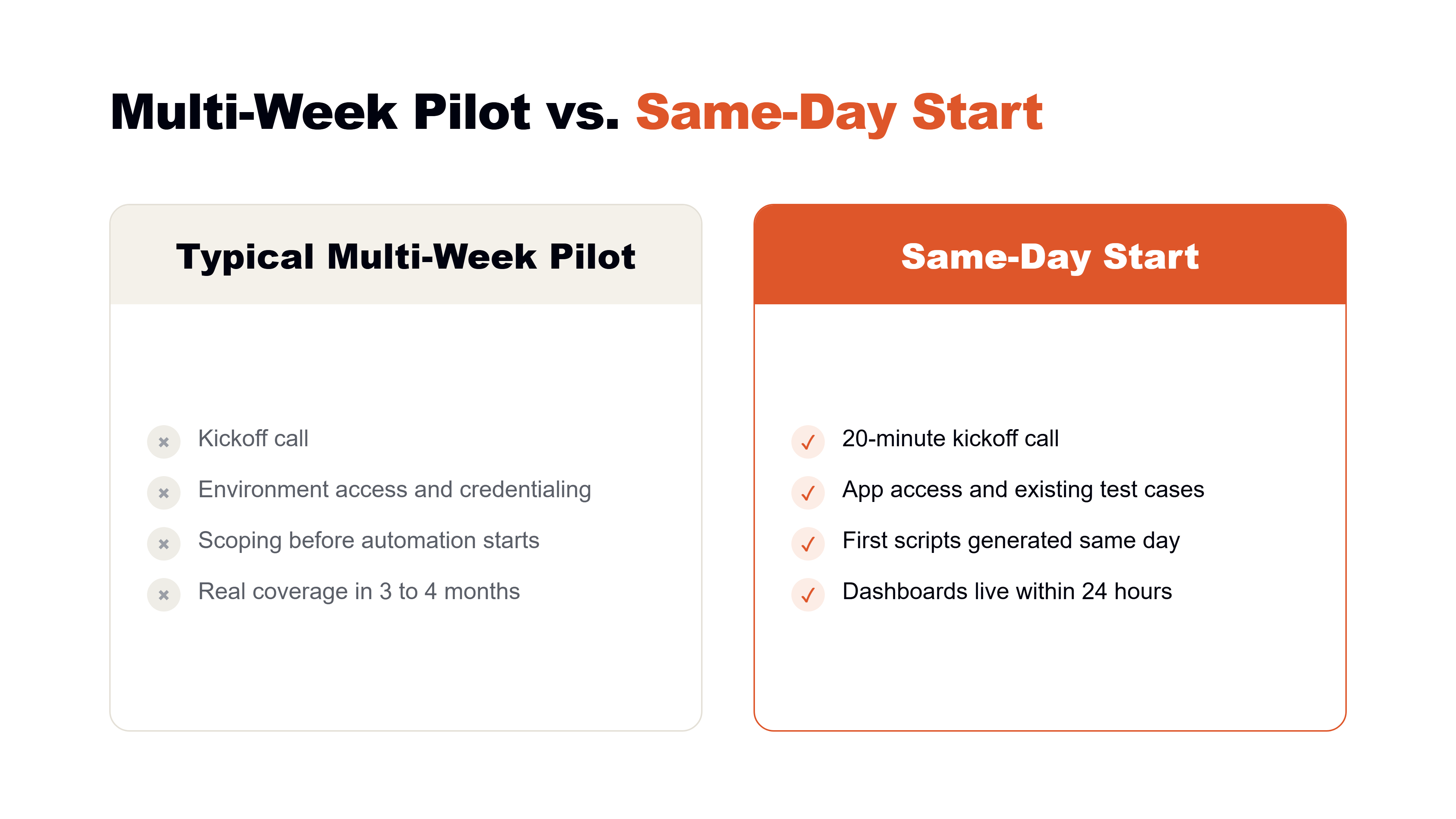
If a vendor can't give you a specific number here, and answers "it depends on your application" with nothing to anchor it, they haven't built a repeatable onboarding process yet.
What Does an AI Testing Services Vendor's Pricing Actually Cost?
Pricing shape matters more than the headline number. A review of AI/QA vendor price sheets found that half required a quote even at a modest reference workload, with no published entry price at all.
The same review quantified a cost that shows up on no invoice: a senior engineer spending about four hours a week on script maintenance and flaky-test triage, at a loaded rate near $75/hour, adds close to $15,600 a year [3].
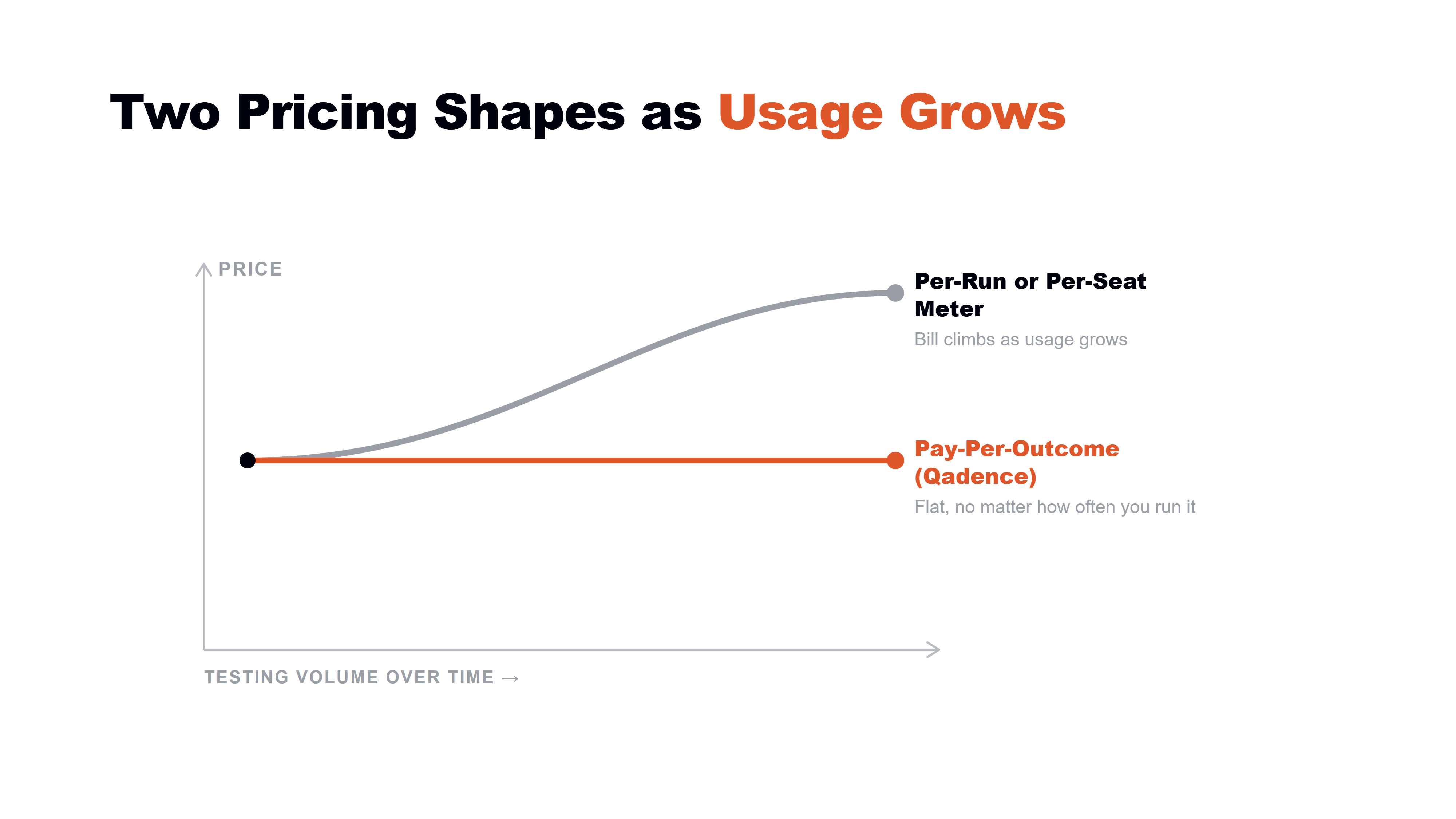
Ask what happens to the bill when the suite runs twice as often next quarter. Only one row in that table answers that without a caveat.
See what your own application's pricing looks like under a pay-per-outcome model.
Claim a $0 Testing Sprint for one test case, automated and engineer-validated at no cost, or get your estimate scoped to your current QA spend.
Does This AI Testing Services Vendor Have Real Experience In Your Industry?
A generalist team can write a technically correct test for almost any login or checkout flow. What they're less likely to catch, without direct prior exposure, is a domain-specific failure: a claims-adjudication edge case in healthcare, a KYC exception in fintech, a provisioning rule that only breaks under a specific carrier's plan-change flow.
Capgemini's 2025 World Quality Report found 89% of organizations piloting or deploying gen-AI-augmented QA workflows, but only 15% at true enterprise scale [4]. That gap is mostly depth and trust, not tooling. Plenty of teams can generate coverage for a pilot. Fewer have shipped and supported it in a regulated vertical at scale, where a team should speak plainly to relevant frameworks (HIPAA, PCI-DSS, WCAG, OWASP) as part of how they test.
Ask for a specific example, not a general claim. A named edge case from a named type of engagement is worth more than "we've worked across every industry."
How Qadence Answers All Three Questions
- Onboarding. A 20-minute kickoff call, then app access and existing test cases. A domain SME sets guardrails and the first scripts generate the same day. Dashboards are live within 24 hours, not after a multi-week pilot.
- Pricing. $20 per test case, unlimited execution runs, volume discounts as test-case counts grow. Pay-per-outcome, never a subscription. Running the suite more often doesn't change the price.
- Vertical depth. Domain SMEs with 17+ years of enterprise delivery experience, concentrated in healthcare, fintech, and telecom.
All three answers assume the same validation gate. Every AI-generated script is reviewed by a QA engineer before it's trusted, and a failed test is human-confirmed before a Jira ticket exists. AI generates the coverage. A person still decides whether it's real.
A $0 Testing Sprint puts one test case through that same process at no cost, with a cost estimate and business case included.
Ask Qadence the same three questions directly.
Claim a $0 Testing Sprint to see the onboarding timeline and validation gate firsthand, or get your estimate to see the pricing shape against your own test volume.
The Scorecard to Bring to Any AI Testing Services Vendor Call
A vague answer in any row is worth pressing on before signing, not after.
Ask These Three Questions Before You Sign With an AI Testing Services Vendor
Onboarding timeline, pricing shape, and vertical depth stop sounding the same the moment a vendor answers with a specific number, structure, or example instead of a general claim.
If a vendor's pricing has ever compounded past the quote, or onboarding ran long enough to matter, these three questions belong at the top of the next call, not the bottom.
Claim a $0 Testing Sprint: one AI-generated, engineer-validated test case automated at no cost, with dashboards showing the results and a business case built around your own application. Prefer a number first?
Get your estimate.
References
[1] Vertice, "Procurement Cycle Time." https://www.vertice.one/insights/procurement-cycle-time
[2] DeviQA, "State of AI-Generated Code 2026: The QA and Testing Gap." https://www.deviqa.com/blog/state-of-ai-generated-code-2026-the-qa-and-testing-gap/
[3] Autonoma AI, "Outsourcing QA Testing? Here's What 6 Vendors Cost." https://getautonoma.com/blog/qa-automation-vendor-pricing-comparison
[4] Capgemini, "World Quality Report 2025." https://www.capgemini.com/us-en/news/press-releases/world-quality-report-2025-ai-adoption-surges-in-quality-engineering-but-enterprise-level-scaling-remains-elusive/