

TL;DR (Executive Summary)
- Functional testing checks whether a feature works, not how well it performs. Non-functional testing covers speed, security, and scale separately.
- Only a handful of functional testing types carry real weight day to day. Smoke, sanity, integration, regression, system, and acceptance testing cover most of what actually ships.
- In-house functional testing costs more than a salary line suggests. A fully loaded QA hire runs well past base pay once benefits, ramp time, and hiring costs are counted.
- Traditional outsourced testing vendors rarely publish a real number. Rates vary widely by region and engagement type, with little transparency before a sales conversation starts.
- Generation alone does not make coverage trustworthy. AI can produce functional test cases quickly, but a QA engineer's validation is what makes that coverage safe to rely on.
Functional testing verifies that a feature works the way its requirements say it should. That sounds like a settled, textbook idea, and in one sense it is.
What has changed is the volume of features shipping through most engineering organizations, and the pace at which they ship. AI-assisted development is part of why: more code now reaches the pipeline in the same release window, and each piece of it still needs verifying before release.
The software testing and QA services market reached $50.67 billion in 2026, growing at 11.5% a year, largely because verification capacity has not kept pace with release velocity on its own [1].
This guide covers what functional testing actually includes, how it differs from non-functional testing, what it costs to run in-house or through an outsourced vendor, and when outsourcing it makes more sense than adding headcount.
Functional testing checks whether a feature works against its requirements. It does not measure speed, security, or scale, a related but separate discipline this guide covers on its own terms later on.
What Functional Testing Checks
Functional testing is black-box verification. A tester provides an input, the application processes it, and the test confirms whether the actual output matches the expected one, without examining the code that produced it.
A login form should authenticate a valid user and reject an invalid one. The test simply confirms whether it did.
Functional testing asks whether a feature works. Non-functional testing asks whether it works well enough under real conditions.
The two measure entirely different things, and neither substitutes for the other. That distinction gets a full comparison later in this guide, but it's worth stating plainly here first.
Take a checkout flow as an example. A functional test confirms that adding an item updates the cart total correctly, that a valid coupon code applies its discount, and that a completed order triggers a confirmation email.
None of that testing measures how fast the checkout page loads or how many concurrent shoppers it can handle. Those non-functional questions get their own section further down.
This is also where "black-box" earns its name. Testers work entirely from the outside, comparing inputs and outputs against documented requirements, with no visibility into the underlying code.
That separates functional testing from code-level disciplines like unit testing, which examine implementation directly rather than observed behavior. Unit testing sits outside this guide's scope for that reason.
A feature can pass every functional test and still fail in production if the non-functional side goes uninspected, and the reverse holds too. A checkout page can load in under a second and still send the wrong discount to every third customer.
Functional testing exists specifically to catch that second failure mode: a feature that runs without errors but produces the wrong result. That's also why a green CI pipeline and genuine release confidence aren't automatically the same thing.
CI/CD pipelines commonly run functional tests automatically on every commit or merge. That's exactly why the maintenance quality of those tests matters as much as their initial coverage.
A pipeline can stay green and still be quietly testing the wrong thing, if nobody keeps the suite current as the application changes.
The Functional Testing Process
The functional testing cycle follows the same basic shape regardless of team size or tooling.
- Requirements analysis. Confirm what the feature is supposed to do before writing a single test case.
- Test case design. Translate each requirement into a specific input, action, and expected output.
- Test data generation. Build or select the data each test case needs to run realistically.
- Execution. Run the test cases and record the actual result against the expected one.
- Defect logging and retest. Log every mismatch, fix the underlying issue, then rerun the test to confirm the fix holds.
Each step feeds the next. Skipping one usually shows up later as a defect that should have been caught earlier in the cycle.
Types of Functional Testing
Functional testing covers more named types than a typical release cycle actually needs day to day. Six carry real weight in most release cycles:
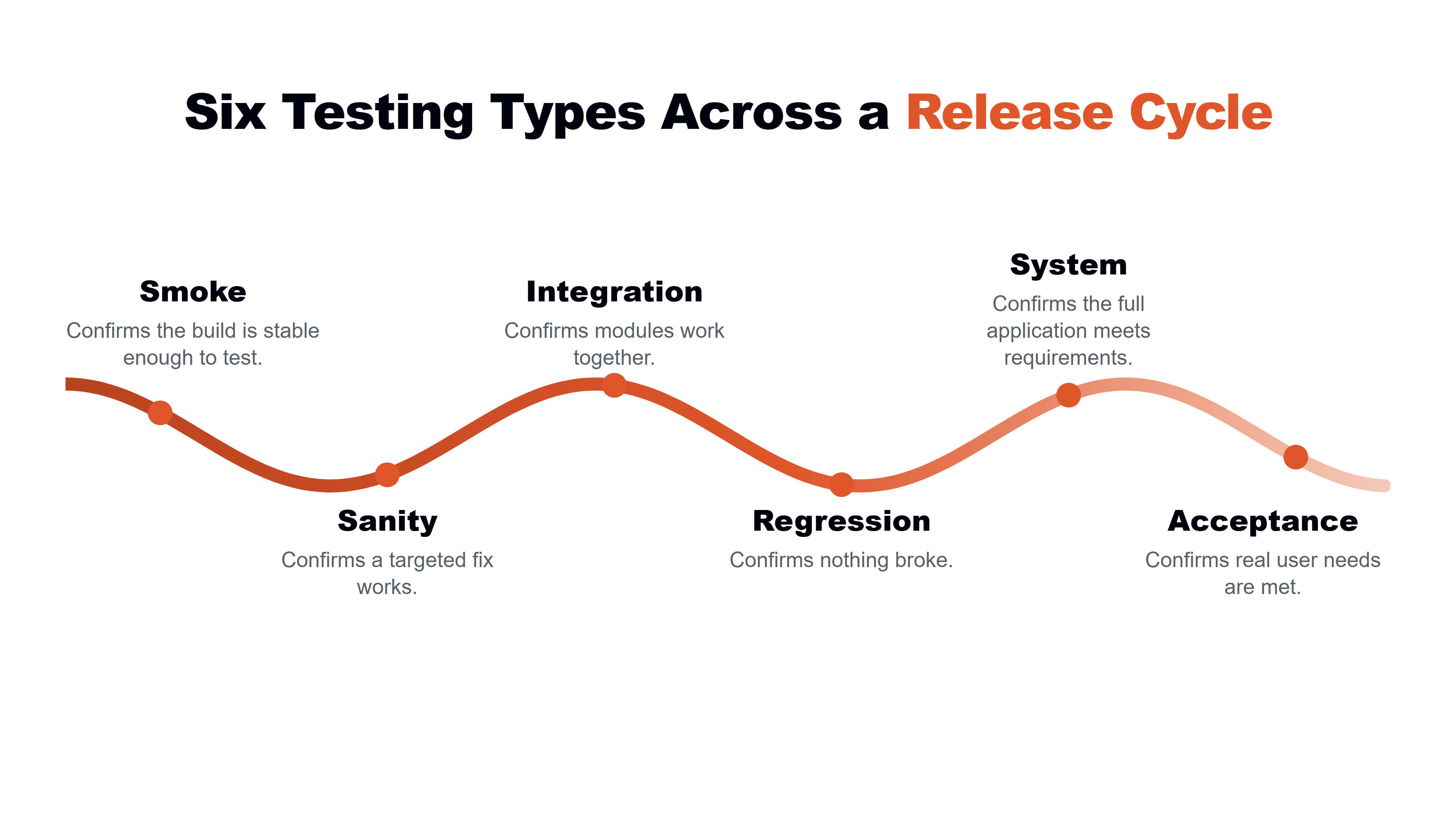
Smoke and regression testing are the two most commonly automated. They run on every build or every release, rather than once per feature.
That frequency is exactly why the maintenance cost of automation matters most for these two types. The cost section below returns to this directly.
Two more types are worth naming on their own. API testing increasingly overlaps with functional coverage, and support for it is expanding across the industry.
It's worth confirming a given vendor's API coverage is actually live rather than roadmap language before relying on it.
Unit testing is a distinct, code-level discipline usually owned by developers rather than a QA function. It sits outside the scope of this guide.
Functional Testing and Non-Functional Testing
Functional and non-functional testing answer different questions about the same application, and both are necessary.
Functional testing asks whether a feature works. Non-functional testing asks whether it works well enough under real conditions, covering performance, security, usability, scalability, and reliability.
Passing one does not guarantee passing the other. An application can process every transaction correctly and still slow to a crawl under load, or it can load instantly and still calculate the wrong total on every third order.
A complete testing program budgets for both. Neither one substitutes for the other.
Teams under time pressure tend to protect functional coverage first, since a broken feature is visible immediately. Non-functional testing often slips until performance or security problems surface in production instead.
Both belong in the same release process from the start, not staged as an afterthought once functional coverage is considered finished.
What Functional Testing Costs
Functional testing carries costs that a single line item rarely captures, whether it runs in-house or through an outsourced vendor.
An in-house QA hire is the clearest example. Base salary alone typically runs $79,000 to $120,000 depending on seniority and region.
Once benefits, recruiting costs, tooling, and ramp time are added, the fully loaded cost of a QA engineer lands closer to $102,000 to $196,000 a year [2].
That figure buys the coverage capacity of one person. Scaling coverage further means repeating that same hire, one at a time.
There is a second cost that's easy to underestimate. Automated test scripts degrade as the underlying application changes: up to 40% go obsolete within six months, purely from UI and feature churn.
Maintenance is a recurring cost on top of the original build, not a one-time expense.
A missed functional defect adds a third cost, harder to line-item but real. Checkout flows with fewer functional bugs convert measurably better.
A severe production outage can cost a public company real, immediate value in the market. The cost of a bug that reaches production is rarely just the fix.
Traditional outsourced testing vendors don't make this easier to plan around. Rates commonly range from $18 to $50 an hour offshore, $35 to $70 an hour nearshore, and $80 to $180 an hour onshore. Managed retainers often run $5,000 to $50,000 or more a month [3].
Almost none of that pricing is published upfront, which makes it difficult to budget for functional testing services with any real confidence before a sales conversation starts.
Qadence prices differently: $20 per test case, with unlimited execution runs and volume discounts as test-case counts grow.
There is no recurring per-run meter and no quote-only sales process standing between a team and a real number.
Coverage that scales with release volume gets more affordable once it stops requiring new headcount every time release velocity climbs.
See how this pricing compares against your own testing spend. Claim a $0 Testing Sprint and get one test case automated and engineer-validated at no cost, or get your estimate scoped to your application.
When to Outsource Functional Testing
Three signals reliably point toward outsourcing functional testing rather than adding another hire.
- Release velocity has outpaced QA headcount, and manual verification is now the visible bottleneck before every release.
- The existing automated suite has gone flaky, with scripts breaking on every DOM change until the team trusts the suite less than the manual process it replaced.
- A hiring freeze has made adding automation engineers impractical, regardless of how real the coverage gap has become.
Qadence pairs AI-generated automation with a QA engineer who validates every script before anything is trusted.
A team either uploads its existing test cases or records a walkthrough once, using a recorder that captures every click, keystroke, and assertion in the browser.
The AI turns either input into executable Playwright scripts. The team owns that code outright and can inspect every line of it.
Every script goes through a QA engineer before it enters the suite. A failed test is human-confirmed before a Jira ticket is ever created.
That validation step is what makes the coverage trustworthy.
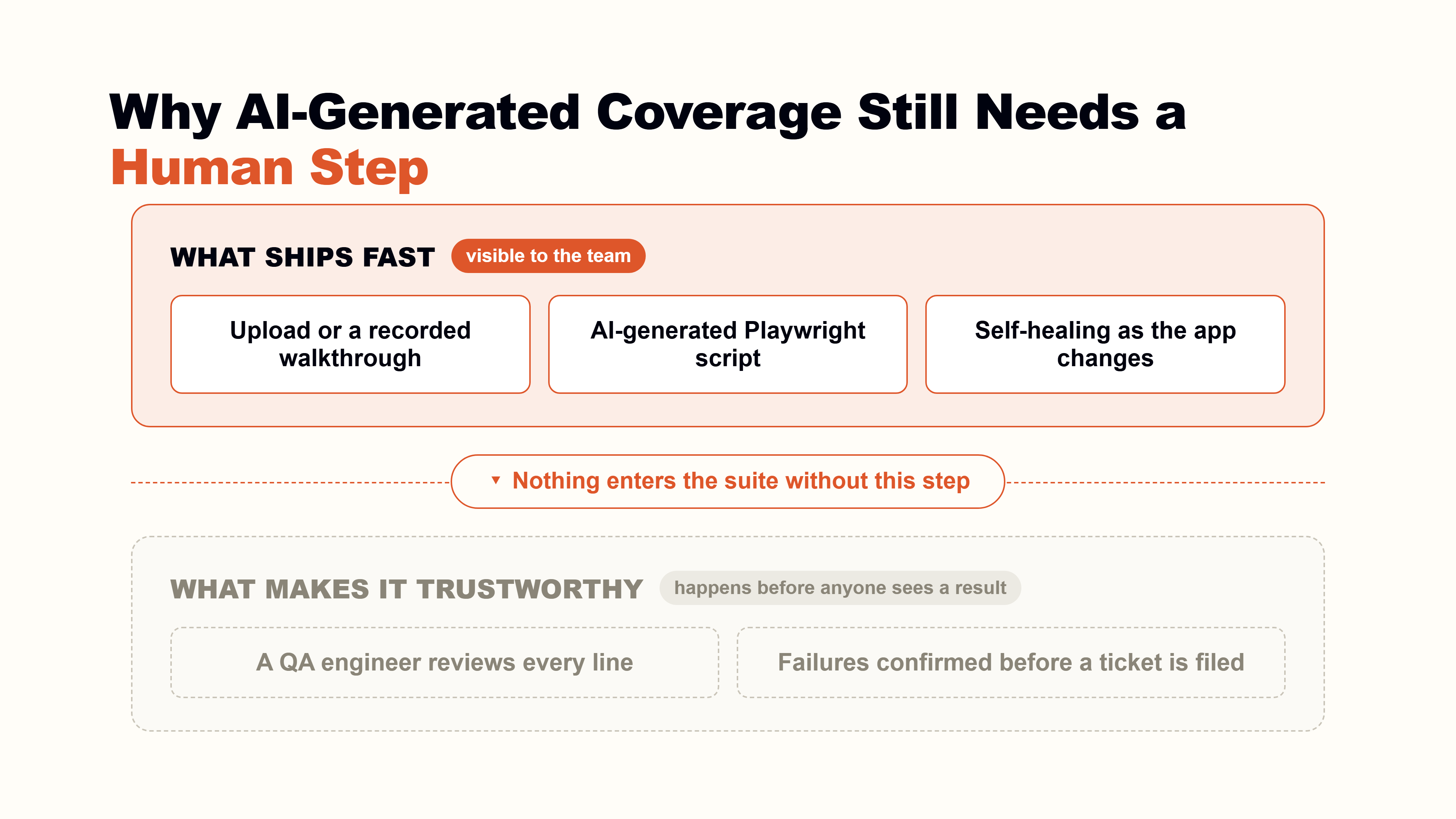
Scripts also self-heal as the underlying application changes, which directly addresses the maintenance tax described earlier. Locator-based breakage gets fixed automatically instead of piling up as unreviewed technical debt.
The same shift shows up in regression cycles. A run that takes days manually typically drops to hours once scripts are automated and self-healing.
The onboarding timeline reflects the same design. Clients start with a 20-minute kickoff call, share app access and existing test cases, and typically see first scripts generated the same day, live in under 24 hours from that first call.
For team sizing, the math is direct. A team of three QA engineers can be replaced by one QA engineer plus the platform, without losing the review step that makes automated coverage safe to rely on.
Regulated teams get an added benefit from the same gate: every reviewed script and confirmed defect leaves a record auditors can trace.
This is also where the broader shift in AI-augmented testing adoption actually lands in practice.
The generation half gets faster every year. The trust problem only gets solved by keeping a person in the loop.
Claim a $0 Testing Sprint and get one test case automated and engineer-validated at no cost, with dashboards showing the gains and a cost estimate scoped to your application. Prefer a number first? Get your estimate.
Key Takeaway
Functional testing verifies the features that actually ship. Getting it wrong costs more than a single budget line usually plans for, whether that shows up as a fully loaded hire, an opaque vendor invoice, or a maintenance tax nobody accounted for separately.
Coverage that scales with release velocity changes that equation. AI can generate the tests fast enough to keep up, and a QA engineer's validation is what makes that coverage safe to rely on.
The types, the costs, and the outsourcing decision all come back to the same question: can testing capacity keep pace with what actually ships?
Claim a $0 Testing Sprint: one AI-generated, engineer-validated test case automated at no cost, with a cost estimate and dashboards scoped to your own application. Prefer a number first?
Get your estimate.
References
[1] Coherent Market Insights. "Software Testing and QA Services Market." https://www.coherentmarketinsights.com/industry-reports/software-testing-and-qa-services-market
[2] Minitap. "QA Engineer Fully Loaded Cost." https://www.minitap.ai/magazine/qa-engineer-fully-loaded-cost
[3] BotGauge. "QA Outsourcing." https://www.botgauge.com/blog/qa-outsourcing